
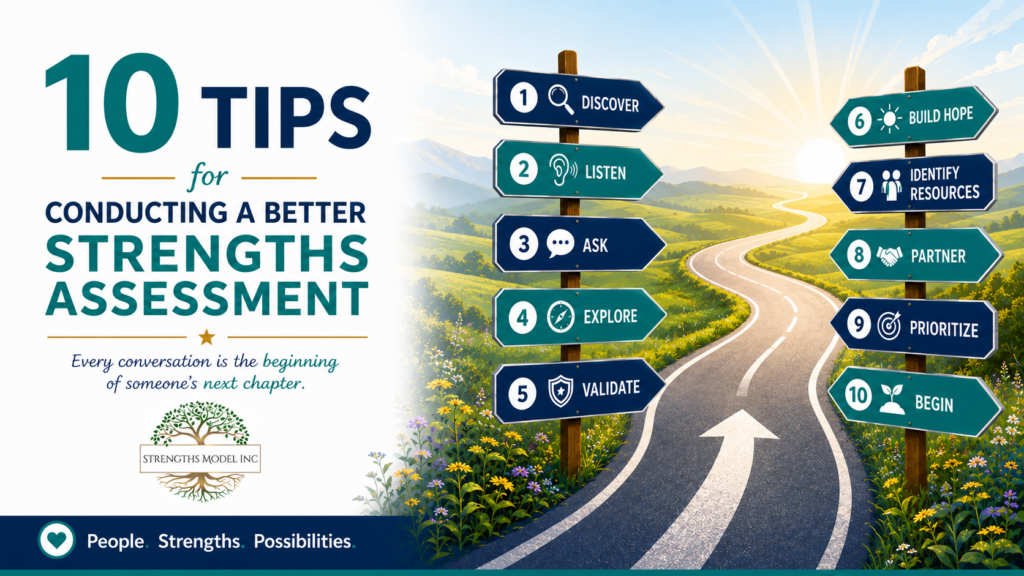
Strengths Model Case Management (SMCM) is an empowerment-oriented approach to case management that focuses on helping individuals move toward meaningful and self-defined values and goals, even in the presence of significant life challenges. Rather than centering on deficits, diagnoses, or limitations, the model emphasizes individuals’ strengths, capabilities, resources, and aspirations as the primary drivers of change.
A key tool within this model is the Strengths Assessment (SA), which serves as a collaborative process for identifying and organizing a person’s values, aspirations, capabilities, useful/helpful personal and environmental resources, and past successes. However, despite its importance within the model, the Strengths Assessment is often misunderstood or implemented in ways that undermine its effectiveness.
The Purpose of the Strengths Assessment
At its core, the Strengths Assessment is not simply a form or documentation requirement. It is a dynamic, relationship-based process designed to help individuals recognize and articulate their strengths, support movement toward personally meaningful goals, and reinforce hope, agency, and self-determination.
Ten Commonly Ignored Best Practices Related to the Strengths Assessment
Growing up, I was a huge fan of the Dave Letterman Show. One of my favorite segments was always the Top Ten List. So, in that spirit, below are our top ten pieces of advice for anyone using the Strengths Assessment in their practice.
Number 10. Establish a meaningful context before introducing the Strengths Assessment.
One of the most common mistakes is getting out a blank Strengths Assessment and trying to start it without a clear reason that is relevant to the person receiving services. The Strengths Assessment should never be introduced without a clear connection to something important to the individual, whether this be a goal they want to move toward (e.g., housing, employment, building relationships, community involvement, etc.), a desire to lessen the negative impact of challenges the person has been experiencing (e.g., symptoms, effects of trauma, substance use, etc.), a behavior change the person wants to make, or just the desire to find a way to make life more manageable.
Before actually introducing the SA, practitioners should first make efforts to understand:
- What the person values
- What the person wants to change or achieve
Only then should the Strengths Assessment be framed as a tool to support movement toward those values and goals.
Number 9. Do not try to complete the assessment in one session.
One of the most common mistakes is attempting to fill out every section of the Strengths Assessment in a single meeting. This approach can feel rushed, transactional, and overwhelming. Instead, the SA should be developed gradually over time. A phased approach allows for deeper understanding, trust-building, and more authentic identification of strengths.
It’s okay for the SA to have several blank boxes initially. As your relationship with the person evolves, so will the SA.
Number 8. Do not start in the upper left-hand corner.
Follow the flow of conversation instead of the structure of the Strengths Assessment. Beginning the assessment in a rigid, top-to-bottom format can make the interaction feel mechanical and disconnected from the person’s immediate concerns. Practitioners should instead follow the natural flow of conversation and prioritize areas that are most relevant or engaging to the individual in the moment.
Number 7. Do not ask, ‘What are your strengths?’
Directly asking individuals to identify their strengths often leads to discomfort or limited responses, especially for those who have experienced significant challenges in their life or are continuously focused on their deficits. Strengths should be uncovered indirectly through conversation about:
- Meaningful and important areas in their life that have been impacted by current challenges
- What the person hopes to move toward or continue moving toward in their life
- What things related to their values is the person still able to do or remain engaged in, even amid the challenges
- What has been useful or helpful to the person to continue doing value-related things in their life
- What has been useful or helpful to the person in dealing with current challenges
Number 6. Do not try to write down on the SA everything the person says.
Focus on connection and capture key themes later. If it helps you organize your thoughts, you can always write down things you are hearing on a separate sheet of notebook paper. Toward the end of the session, you can use the Strengths Assessment to capture key pieces of information that arose during the conversation that may be important to help the person either get started or continue in their journey of recovery. For example, on the SA, you might write:
- A few things the person hopes to move toward (desires & aspirations)
- A few things they are still able to do, even amid current life challenges (capabilities)
- A few of the efforts they are making related to what they value or goals they want to move toward (capabilities)
- A few things that might be helpful or useful to help them continue moving toward goals or values that are important to them (personal and environmental strengths)
Number 5. Avoid transposing deficits or entrapping narratives onto the assessment.
One of the powerful ways the Strengths Assessment can be used as a behavioral health intervention is by “creating space” between distress or discomfort caused by life challenges the person is experiencing and the strengths (values, aspirations, goals, capabilities, personal and environmental strengths) that might help them move forward in life even amid these life challenges. While challenges are what people often talk about when they are seeking help, recording them all on the Strengths Assessment merely brings people’s focus back to the thoughts, feelings, and emotions that are distressing, uncomfortable, or overwhelming. People’s life challenges should always be validated with empathy. The goal of the Strengths Assessment, though, is to help people see the possibilities of a pathway forward in life even amid these challenges.
Number 4. Only record strengths the person can acknowledge.
Even if a practitioner observes strengths, they should not be recorded on the Strengths Assessment unless the individual can recognize or accept them. Remember, the Strengths Assessment is part of an evolving conversation between the worker and the client over the course of the helping relationship. When a person’s central nervous system has been repeatedly conditioned to respond to distress, it can be challenging for them to see the well aspects of themselves.
That is why it is okay to start a Strengths Assessment slowly at first. It may be just helping the person reconnect to a few key values they have or a goal they want to move toward. Or it could be helping the person to mindfully become aware of small efforts they are making or the things they are still able to do. Or it might be helping the person to focus on anything that is helpful or useful to them in the moment. The intent is to authentically and mindfully highlight resilience, resourcefulness, hope, and capability.
While starting a Strengths Assessment doesn’t mean that all the person’s challenges are gone, it does help the person see that they are not beginning this journey empty-handed. As the Strengths Assessment evolves over the course of the helping relationship, the person is able to see the empowering aspects of how they are building (or rebuilding) their life around their strengths.
Number 3. Limit direct interaction with the Strengths Assessment tool to brief periods.
I have found that some of the greatest impact of the Strengths Assessment occurs when we spend less than five minutes directly using it during a session. Most of our time with the person should be spent actually doing tangible work that helps a person move toward a valued goal, addressing a challenge or obstacle that is impeding goal-oriented work, or discussing/evaluating options in order to take a specific action. Yet, out of the work we do with people, strengths are continuously emerging. These might include clarification around a goal the person wants to move toward, a new effort the person made, a helpful/useful personal or environmental resource being used, something useful/helpful the person has added to their life, or a new awareness of something that is contributing to the person’s overall health and well-being. You don’t have to use the Strengths Assessment in every session, though it does help to periodically return to the Strengths Assessment so the person can see the movement that is occurring.
Is it okay if I work with the person on the Strengths Assessment for more than five minutes? Of course, just be intentional about why you are spending more time on it and make sure the person is engaged and views it as helpful. This may occur early on in the helping relationship when you are working collaboratively with the person to develop an initial support plan, or when you want to pause to consolidate the progress the person has made, or begin discussing graduated disengagement from services.
Number 2. Remember that YOU are the primary tool in the Strengths Model.
The most important element in the Strengths Model is not the tools (Strengths Assessment and Personal Empowerment Plan) —it is the practitioner. Skills such as active listening, empathic communication, curiosity, hope-inducing practice, consistent invitations to explore or act, respect for people’s choice and autonomy, among others, are what bring the model to life. The Strengths Assessment, along with the Personal Empowerment Plan, are simply visual supports for these relational processes.
Number 1. Embrace the principle of “learning for a living”.
Mastery of the Strengths Model does not occur quickly. It requires ongoing learning, reflection, and practice. And yes, even mistakes. Practitioners should adopt a mindset of:
- Gradual improvement
- Openness to feedback
- Persistence in applying strengths-based principles
This long-term commitment is essential for true proficiency.
Implications for Practice
When these principles are ignored, the Strengths Assessment risks becoming a compliance-driven task rather than a meaningful intervention. When implemented effectively, the Strengths Assessment enhances engagement, strengthens the working alliance, and promotes meaningful progress toward personal goals. Organizations should support practitioners through training, supervision, and fidelity monitoring to ensure these principles are applied consistently.
Conclusion
The Strengths Assessment is a powerful tool when used as intended. By maintaining a person-centered, strengths-oriented, trauma-informed approach, practitioners can transform the Strengths Assessment into a meaningful process that supports empowerment and recovery. Ultimately, the effectiveness of the model depends on the practitioner’s mindset and approach.