Rick Goscha, PhD
If you work in behavioral health, you are familiar with the terms coping strategies or coping skills. We teach them to help people manage symptoms, regulate emotions, and navigate psychological distress. Having ways to respond to uncomfortable or distressing thoughts, feelings, or challenges we face in life is helpful. I employ various strategies in specific situations. For example, I use diaphragmatic breathing when experiencing heightened anxiety while doing something uncomfortable or a mindful body scan if I am ruminating on unhelpful thoughts, making it difficult to sleep.
Unfortunately, I have seen a growing trend in behavioral health of overemphasizing the teaching of coping skills and not paying enough attention to helping people engage in activities that bring a sense of meaning, purpose, joy, and contentment. This is not an either/or, it’s a both/and. And bringing them both together within the context of moving toward what we value and want in life is a powerful combination.
When Coping Becomes the Focus
Coping strategies/skills are often introduced to people when they are:
- Experiencing considerable amounts of stress or anxiety.
- Bombarded with uncomfortable or distressing thoughts or feelings.
- Ruminating on past experiences
- Worrying about future events.
- Overwhelmed with life challenges.
In moments like these, internal dysregulation can affect external agency. In other words, the distress a person is experiencing has overwhelmed their ability to act. The teaching of coping strategies/skills can be useful to restore that balance and create space for the person to better respond to the stressors/challenges in their life.
The Hidden Problem
In many behavioral health settings, there is a larger narrative that is often embedded within many behavioral health providers’ approaches to teaching coping strategies. At the center of this narrative is a view that tightly binds symptoms experienced to a diagnosis/condition/disorder that will require ongoing efforts to keep it from worsening. This places the spotlight on the diagnosis/condition/disorder as the primary explanatory framework for anything the person may experience that is distressing or uncomfortable.
Over time, this can subtly reinforce a narrative for the people we serve:
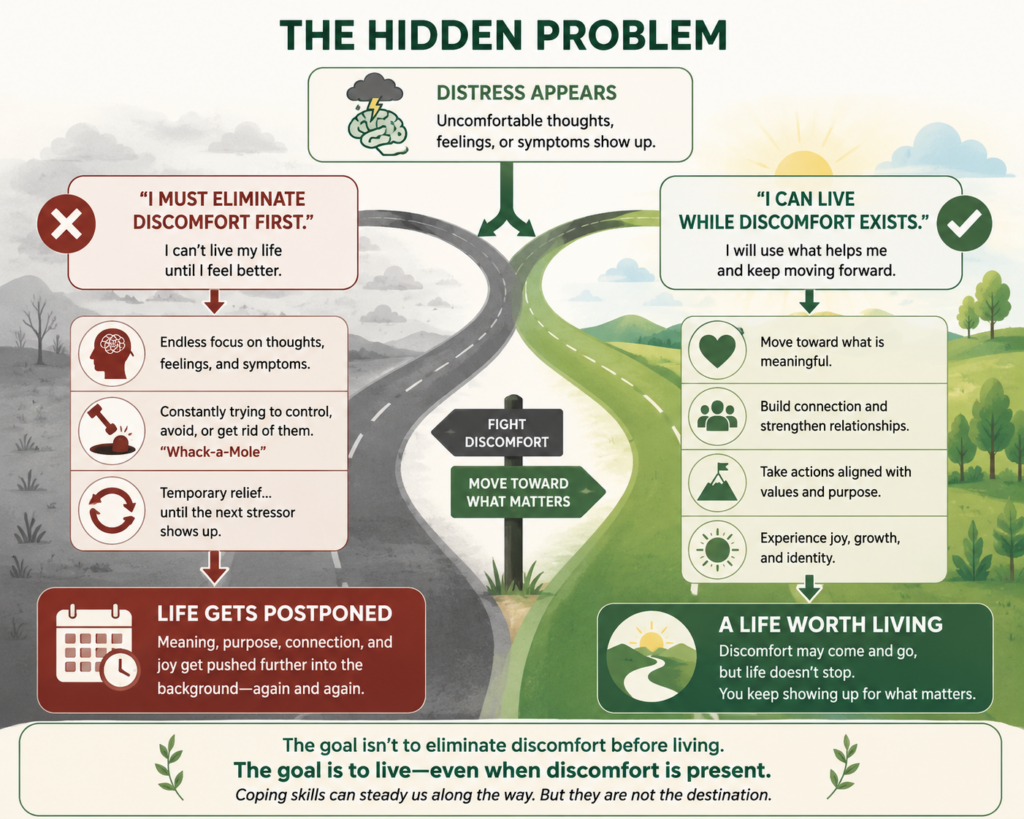
“Once I get my thoughts, feelings, emotions, and symptoms under control…
… then I can start living my life.”
This belief is a trap.
When we make our life about fighting symptoms or controlling unwanted thoughts, feelings, or emotions, then we end up amplifying their intensity. We start to widen the chasm between where we are presently and the values and life we desire to move toward. We reinforce a misguided belief that once we get on the other side of everything we are experiencing inside, we can finally fully live our lives.
The use of coping skills can become reduced to an ongoing symptom “whack-a-mole” activity. Something distressing shows up internally, we knock it down with a coping strategy and move on – until the next stressor appears. Meanwhile, life—the meaningful, connected, purposeful part—gets pushed further and further into the background.
We Are More Than What We Struggle With
We can spend so much time each week putting our efforts into coping that we stop actually living at all. Core beliefs of the Strengths Model are that we are more than:
🧠 Symptoms
Experiencing symptoms can be difficult, but symptoms do not define who we are.
📋 Diagnoses
A diagnosis may help to understand experiences, but it does not define identity.
♿ Disabilities
Disability may create challenges, but it does not diminish strengths, hopes, or potential.
🔄 Addiction
Addiction may disrupt life, but it does not erase dignity, values, or the possibility of growth.
🩹 Trauma
Traumatic experiences can leave lasting wounds, but they do not have the final say over our future.
🏷️Labels
Labels imposed by others may influence how we are seen, but they do not determine who we are or who we can become.
For many, various things on this list may have caused significant disruptions in our lives. However, we do not have to give them more power than they deserve. When we give them too much power, we unintentionally shrink the space available to pursue things, people, and places that bring meaning, purpose, and connection in our lives.
Shifting from Coping to Engaging in Life
Strengths Model Case Management (SMCM) is fundamentally about shifting the center of gravity from managing problems to building a life worth living. This isn’t about abandoning coping skills. It’s about putting them in their proper place. We view coping skills as support for action, not the goal itself.
What often gets overlooked when we have a myopic focus on teaching coping skills is helping people actively engage in:
- Activities that bring joy
- Experiences that create connection
- Moments that reinforce identity
- Actions aligned with personal values
This is where real change happens. For any of us, not just the people we serve in our programs.
Reclaiming What Matters
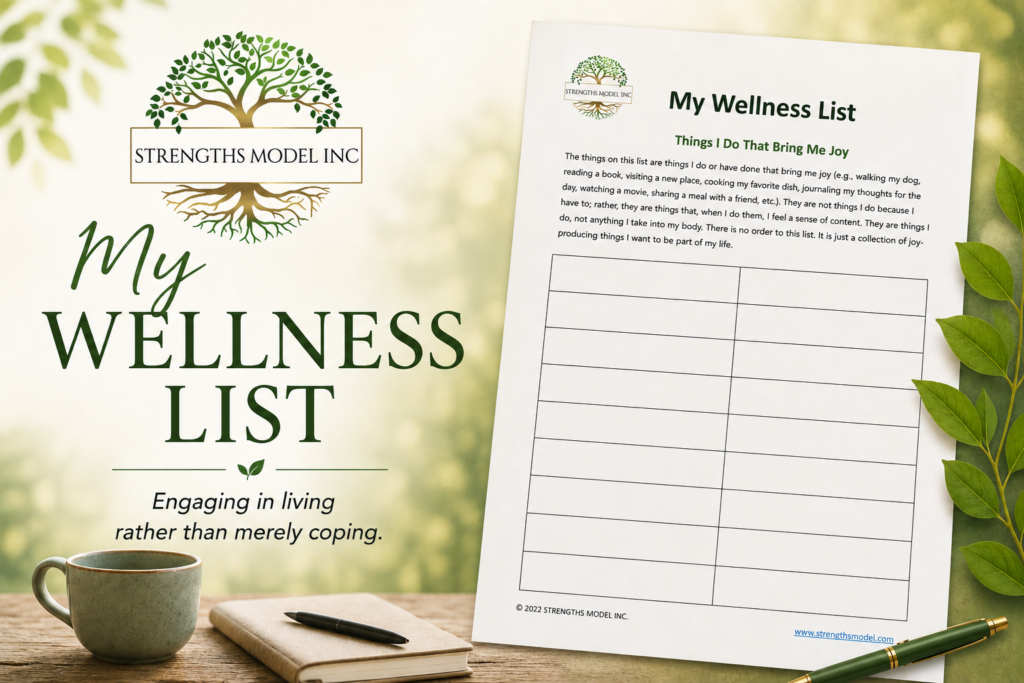
One practical way to begin shifting from coping to living is through another simple tool within Strengths Model Case Management: My Wellness List. It is a worksheet that can help a person slowly reclaim some of the activities that are of value to them in their lives. Email me at rick@strengthsmodel.com if you want a copy of the worksheet below to try out yourself.
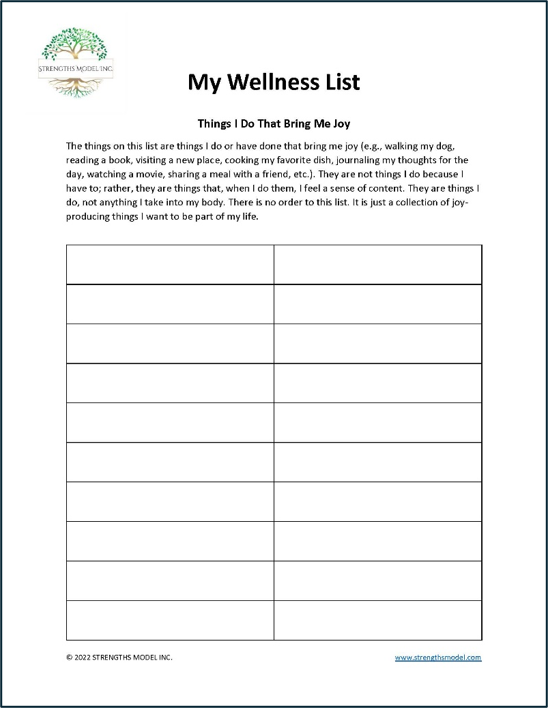
This isn’t a to-do list like the Personal Empowerment Plan. It is a reconnecting tool.
These are activities that not only bring you joy; they are also intricately bound to things that have meaning to you, give you a sense of purpose and connection, and are part of your identity. Writing things down on this list isn’t intended to overwhelm you; rather, it is to draw them to the forefront of your awareness.
Initially, you do not need to do anything with them. You can just allow them to exist. Some of the things on the list will be things you are already doing. Others are things you would like to be part of your life. Release any judgment on yourself if there are things you feel you have neglected or are not doing as much as you would like. Release your judgment on others if you feel people have done things that have separated you from these activities. Allow yourself the opportunity to just visually reconnect to the words you have written. Allow yourself to reconnect to why you enjoy doing some of these things and the internal changes you experience when you are doing them.
Here are a few from my own Wellness List:
| Playing ball with Kobe (my dog) | Watching the hummingbirds outside |
| Cooking a meal with Shelly (my partner) | Connecting with one of my kids |
| Listening to a new song or music group | Going on a walk with Shelly and the dogs |
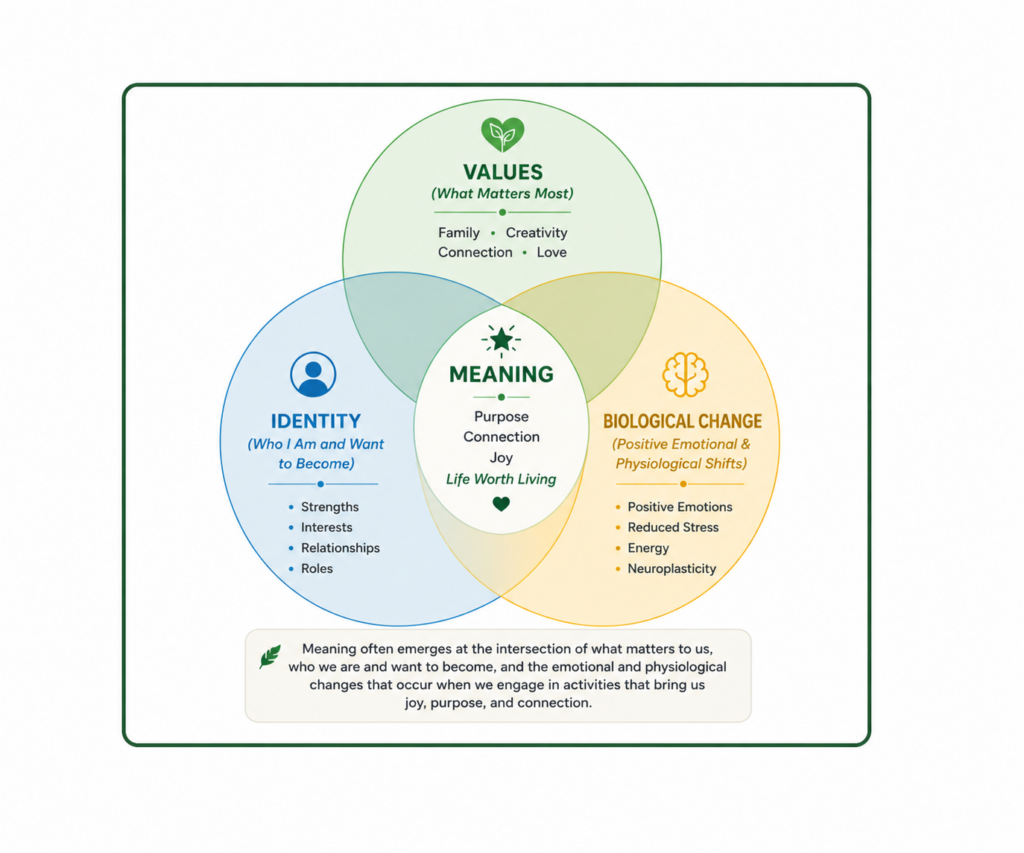
They may seem like a few basic activities. However, they are each packed with a ton of power. That’s because each is connected to:
- a deeply held value (e.g., family creativity, connection)
- a sense of identity (who I am and want to be)
- A biological/neurological shift (positive emotional and physiological changes)
The Real Goal
The goal isn’t to eliminate discomfort or distress before living.
The goal is to live—even when discomfort or distress is present.
Coping skills can help you steady yourself along the way. But they are not the destination.
When we help people move toward what matters—toward meaning, purpose, and connection—we’re no longer just helping them cope.
We’re helping them engage in living.
Interested in Learning More About Strengths Model Case Management?
- SMCM training opportunities
- Implementation support
- Coaching and consultation
- Practical tools for strengths-based work
Contact Rick Goscha at rick@strengthsmodel.com